
Home/Roadmap Studies
Building Electrification Roadmaps
Building electrification means high-stakes decisions with real consequences spanning multiple decades — if not more. Electrify now, or continue with business as usual? Retrofit or replace? Each facility is also unique in its own right — how do you choose, and in what order?
The commitment to electrification (or not) is the easy part. In fact, most towns considering building electrification already have a climate action plan or Green Communities designation driving their action toward electrification. What is hard is navigating an extremely complex landscape — technology choices, tight budgets, and competing demands every town has to balance.
ENHUEX is an engineering firm. We do not tell you which pathway to take. Our goal is to work with you to understand your circumstances, do the engineering that untangles that landscape, and give you a documented basis to decide for yourself.
What we deliver
We deliver the pre-deployment analysis, the assumptions, and the sensitivities to the numbers behind each pathway — so you can decide what fits your mandates, budgets, and constraints. For example, a lifecycle analysis of each pathway by category — capital, utility, and maintenance — puts electrify vs business as usual on one shared basis so a town can see:
- What each pathway costs over a defined horizon
- How the numbers move if utility rates or equipment costs shift
- Which buildings should convert first, and why
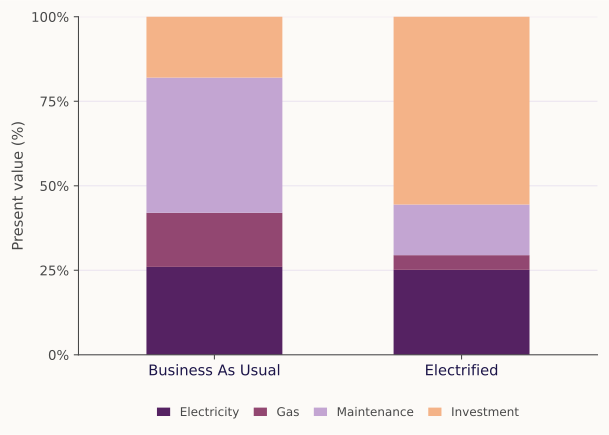
You get a planning-level cost basis for the whole portfolio — cost per square foot, calibrated to building age, construction type, and regional labor and material costs. We bring different facilities onto a common basis for easy comparison, without the cost, time, or burden of building-specific detailed engineering design work. This gives a documented basis for informed discussion with the select board, school committee, or other town bodies.
What you provide
You do not need a design study or a walkthrough of every building. What we typically need from the town:
- Annual energy usage — typically from utility bills
- Building details, building management system, weatherization details
- A building system inventory — HVAC, hot water, and related equipment (age, type, capacity)
That is usually enough. We help assemble it from records you already keep. Site visits only if something cannot be read from the paperwork.
What you get
- A portfolio-wide lifecycle analysis across every pathway modeled
- Facility-level capital, utility, and maintenance projections by year
- A phased timeline so facilities can be sequenced independently
- An executive summary built for board or committee review
- Full assumption documentation, with sensitivity reporting
- Delivered as a clean PDF report
Evidence: Town of Chelmsford, MA
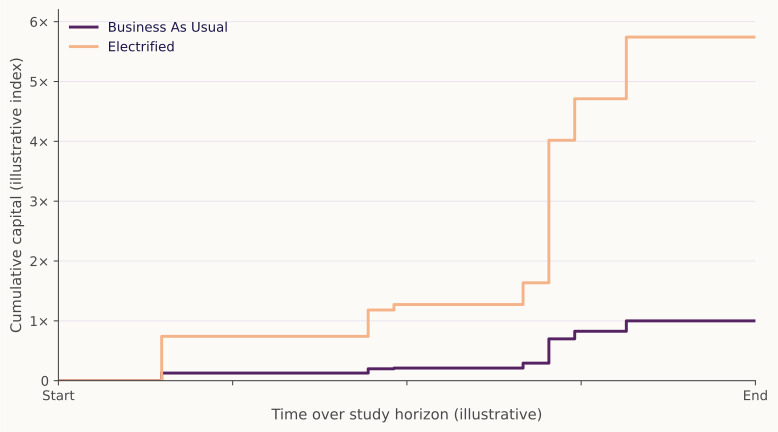
We delivered this kind of building electrification roadmap study for the Town of Chelmsford in Massachusetts, covering a portfolio of nine public school buildings, total of 826,048 square feet, built from 1955 to 1974. Electrify and business-as-usual pathways were analyzed over a period of 28 years (2024–2051) — capital, utility, GHG emissions, and maintenance, with all assumptions documented.
- Delivered Roadmap Report on the Town website. Read the report →
- Example DPW use of this analysis in a public project update to the Town. View DPW presentation →
- School Committee Discussion on Electrification. Watch the meeting →
For the full engagement story — how the work was scoped, delivered, and used — see the Chelmsford case study →
Frequently asked questions
We have a Climate Action Plan — do we still need this?
A Climate Action Plan sets the commitment. It usually does not price electrify vs business as usual at the building level. What we deliver sits downstream of that plan: a facility-level cost comparison so the people who have to decide can weigh the pathways on one basis.
We already have a Green Communities roadmap — we don't need another roadmap, do we?
Most Climate Leader Communities already have one — it is part of certification. By design, that roadmap skips building-level costs. This is a different document: unit-cost pathways across your portfolio, with assumptions stated, for the calls that come after the designation checklist.
Do we need to schedule site visits?
Usually no. We work from utility bills and a building system inventory. If something cannot be read from the records, we flag it and decide together whether a visit is worth it.
What if utility rates or technology costs change after delivery?
Every output carries a documented sensitivity to the assumption driving it. You can see how the numbers move without commissioning a new study.
How do towns typically fund a study like this?
Many Climate Leader Communities use the state's Climate Leader Decarbonization Technical Support Grant, or similar state funding, for this kind of study.
This is one part of how we approach Pre-Deployment Planning. The Chelmsford case study shows a full delivery.